


Table of Contents
- CLP or CPSR? A Friendly Guide for Confused Makers
- What Do CLP and CPSR Actually Mean?
- Why This Gets Confusing So Quickly
- Let’s Make It Simple: Product Categories Matter
- A Helpful Way to Remember It
- The Most Common Mistakes Makers Make
- Do You Ever Need Both CLP and CPSR?
- Why Getting This Right Matters
- A Quick Reality Check for Makers
- Final Thoughts: You’re Closer Than You Think
- FAQs
CLP or CPSR? A Friendly Guide for Confused Makers
If you’ve spent any time researching how to sell your handmade products, you’ve probably come across the question: CLP or CPSR? And if we’re being honest, it’s not always explained in a way that actually makes sense.
You might have seen people confidently say you “need CLP labels” or that “everything requires a CPSR”, without really explaining why. So you’re left wondering which one applies to your products - or worse, whether you’re missing something important.
If that’s where you are right now, take a breath. This confusion is incredibly common, especially when you’re working with products that seem similar on the surface but fall under completely different rules.
In this guide, we’ll walk through this in a way that’s simple, practical, and actually useful - so you can move forward feeling clear, not overwhelmed.
What Do CLP and CPSR Actually Mean?
Let’s start by removing the jargon.
When people ask about CLP labelling or CPSR, they’re really asking about two different types of requirements::
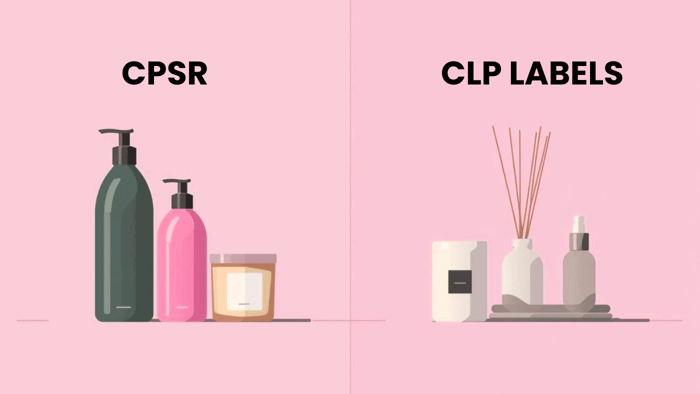
- CLP (Classification, Labelling and Packaging) applies to products that may pose hazards such as irritation or flammability. These are typically products that are not applied to the body but are used in the environment around you. Examples include candles, wax melts, reed diffusers, and room sprays - anything designed to scent the air or fragrance a space. CLP ensures that any potential risks are clearly communicated to the user through proper labelling.
- CPSR (Cosmetic Product Safety Report) applies to products used directly on the body and ensures they are safe for skin application. These include items such as lotions, creams, perfumes, body mists, soaps, and other skincare or personal care products that are applied to the skin. CPSR focuses on assessing the safety of the finished cosmetic product to ensure it is suitable for use on the body.
At a glance, they can feel similar because both relate to safety - but they serve very different purposes.
One focuses on warning the user about risks.
The other focuses on proving the product is safe to use.
Understanding that distinction is key when deciding between CLP or CPSR.
Why This Gets Confusing So Quickly
A big reason people struggle with CLP labels or CPSR is that many products use the same ingredients - especially fragrance oils.
For example:
- A lavender fragrance oil might be used in a candle
- The same oil could be used in a lotion
Same ingredient, completely different outcome in terms of compliance.
This is where many makers get caught out. It’s easy to assume that if an ingredient comes with hazard information, then every product made with it must follow the same rules.
But the truth is, the type of product you create determines whether CLP or CPSR applies - not the ingredient alone.
Let’s Make It Simple: Product Categories Matter
When deciding between CLP or CPSR, the most helpful question you can ask is:
Where is this product being used?
If your product is used on the body:
Think:
- Soaps
- Lotions
- Creams
- Body scrubs
- Lip balms
These are considered cosmetic products.
👉 In this case, you need a CPSR.
If your product is used in the environment:
Think:
- Candles
- Wax melts
- Reed diffusers
- Room sprays
- Carpet Freshener
- Hoover discs
These fall under chemical mixtures rather than cosmetics.
👉 In this case, you need CLP labelling.
This is the core of the CLP or CPSR decision. Once you understand which category your product belongs to, everything else becomes much clearer.
A Helpful Way to Remember It
If you’re someone who likes simple rules (and let’s be honest, we all do), here’s one that sticks:
👉 On the body = CPSR
👉 In the air or space = CLP
That’s the easiest way to navigate CLP or CPSR without overthinking it.
The Most Common Mistakes Makers Make
When it comes to CLP or CPSR, there are a few patterns that come up again and again -- especially for beginners.
1. Assuming CLP Covers Everything
Some makers believe that having CLP labels means their products are fully compliant. While CLP is essential for home fragrance, it does not apply to cosmetics at all.
So if you’re selling soaps or skincare, CLP won’t replace the need for a CPSR.
2. Thinking Cosmetics Need CLP Too
This is another common misunderstanding. Because fragrance oils often come with hazard warnings, it can feel like those warnings must carry over into cosmetic products.
But once a product is classed as a cosmetic, it is regulated differently. This is why the CLP or CPSR distinction matters so much.
3. Relying Only on Supplier Documents
Suppliers often provide helpful information like safety data sheets or usage guidelines. However, these documents don’t automatically make your final product compliant.
In the context of CLP or CPSR, your responsibility begins when you create a finished product. What you do with the ingredients changes everything.
4. Judging by Appearance Instead of Category
Sometimes products look similar but fall under different rules.
For example:
- A room spray → CLP
- A body mist → CPSR
Even though both are liquids in spray bottles, they are treated completely differently from a compliance perspective.
This is why understanding CLP or CPSR isn’t about guessing - it’s about correctly identifying your product type.
Do You Ever Need Both CLP and CPSR?
This is one of the most frequently asked questions when discussing CLP or CPSR.
The answer is:
👉 Not for the same product.
A single product will fall into one category or the other.
However, if your business sells different types of products - for example, candles and skincare - then you will need to deal with both CLP or CPSR across your product range.
Just not at the same time for the same item.
Why Getting This Right Matters
It might be tempting to see CLP or CPSR as just another admin task, but it plays a much bigger role than that.
Getting it right means:
- Your products are safer for your customers
- Your business is more protected
- You build trust with buyers
Getting it wrong, on the other hand, can lead to confusion, inconsistent labelling, or even compliance issues down the line.
And while that might sound intimidating, the good news is that understanding CLP or CPSR is one of those steps that quickly becomes second nature once it clicks.
A Quick Reality Check for Makers
If you’re feeling unsure or even slightly overwhelmed reading all this, that’s completely normal.
Most makers don’t start out knowing the difference between CLP or CPSR. It’s something you learn as you go, often after seeing conflicting advice or trying to piece together information from different sources.
What matters is that you’re asking the question now.
Because once you understand this, you’re no longer guessing - you’re making informed decisions about your products.
Final Thoughts: You’re Closer Than You Think
The whole CLP or CPSR question can feel bigger than it actually is. But when you break it down, it really comes back to one simple idea:
👉 What is your product for?
- If it’s designed for use on the body → CPSR
- If it’s designed to scent a space → CLP
That’s it.
You don’t need to memorise complicated regulations or second-guess every ingredient. You just need to correctly identify your product category and follow the right path from there.
And if you’ve made it this far, you’re already ahead of where most people start.
So if this topic has been sitting in the back of your mind, consider this your moment of clarity. You’ve got a better understanding now - and that’s a solid step forward for your business.
Discover Premium Fragrance Oils
Disclaimer
This blog is for general informational purposes only and is not intended as legal or regulatory advice. While every effort has been made to ensure accuracy, regulations surrounding CLP and CPSR may vary depending on your location and specific product formulations. It is the responsibility of the manufacturer or seller to ensure full compliance with all applicable laws and requirements. Always consult with a qualified professional or regulatory authority if you are unsure.
FAQs
Do I need both CLP and CPSR for one product?
No, a single product will only require one. CLP applies to home fragrance products like candles and wax melts, while CPSR applies to cosmetics such as soaps and skincare.
Do soaps need CLP labelling?
No, soaps are considered cosmetic products, so they require a CPSR instead of CLP labelling.