




Table of Contents
- Why Visual Identity Matters More Than Ever
- The Psychology of Colour in Brand Content
- Typography: The Voice Behind the Words
- Readability vs Aesthetic: Finding the Balance
- Emotional Alignment: Matching Visuals to Message
- How Colour Influences Buying Decisions
- Typography and Authority
- Social Media: Where Visual Identity Is Tested
- Website and Blog Design
- Common Mistakes to Avoid
- Practical Steps to Refine Your Visual Identity
- The Subtle Power of Cohesion
- FAQs
How Colour and Typography Influence Your Brand Content
Brand content shapes first impressions in powerful ways. When someone lands on your website, scrolls past your Instagram post, or opens your latest email, they make a decision about your business in seconds. Before they’ve read a single sentence properly, they’ve already felt something.
That feeling is rarely created by words alone. It’s shaped by colour. It’s reinforced by typography. And together, these two elements quietly determine how your brand content is perceived.
In a world where attention spans are short and competition is fierce, the visual language of your business matters just as much as what you say. In this guide, we’ll explore how colour and typography influence your branding, how they affect trust and buying behaviour, and how to use them more intentionally.
Why Visual Identity Matters More Than Ever
We live in a scroll-heavy culture. Your audience isn’t carefully analysing every post — they’re skimming, swiping, and making snap judgements.
Visual consistency helps your brand content become recognisable at a glance. When someone sees your specific shade of sage green or your clean, elegant serif heading, they begin to associate that look with your business. Over time, that builds familiarity. And familiarity builds trust.
Inconsistent colours and mismatched fonts, on the other hand, create friction. They can make even the most beautifully written content feel disjointed or unprofessional.
Strong visual identity does three key things:
Creates immediate recognition
Builds emotional connection
Enhances perceived professionalism
And all of this happens before your audience consciously realises it.
The Psychology of Colour in Brand Content
Colour is emotional. It speaks directly to the subconscious.
While personal preference always plays a role, certain colours tend to evoke particular feelings:
Blue – trust, calm, reliability
Green – growth, nature, balance
Pink – warmth, femininity, playfulness
Black – luxury, authority, sophistication
Yellow – optimism, energy, friendliness
Beige and neutrals – minimalism, softness, simplicity
When you choose colours for your brand content, you’re choosing the emotional tone of your communication.
For example, a wellness brand using soft neutrals and muted greens creates a very different atmosphere from a high-energy fitness brand using bold reds and electric blues. Both may be successful, but they are speaking to different emotional triggers.
Colour Consistency Builds Memory
Repetition strengthens recognition. If your Instagram graphics are blush pink, your website banners are navy, and your emails are bright orange, your brand content feels scattered.
Selecting a defined colour palette — typically 3 to 5 core shades — creates cohesion. It ensures that every piece of content, from blog headers to social graphics, feels connected.
Over time, your audience begins to recognise your business from colour alone. That is powerful brand equity.
Typography: The Voice Behind the Words
If colour sets the mood, typography sets the tone of voice.
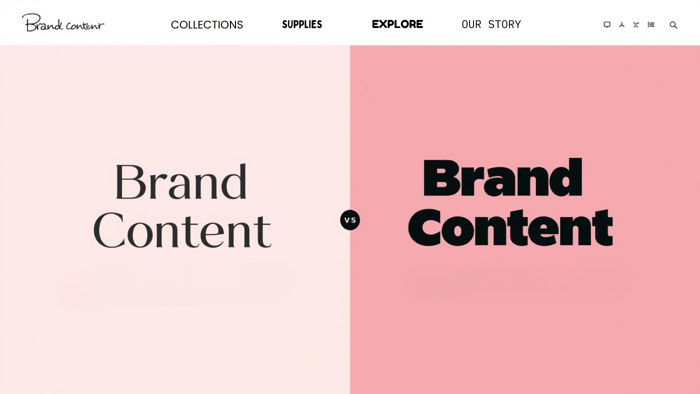
Typography is not just about readability. It communicates personality. The same sentence written in a flowing script font feels entirely different from one written in a bold, condensed sans-serif.
Here’s how different font styles influence perception:
Serif fonts (with small finishing strokes): Traditional, refined, trustworthy
Sans-serif fonts (clean, modern): Minimal, approachable, contemporary
Script fonts: Personal, elegant, creative
Display fonts: Bold, expressive, attention-grabbing
Your choice of typography directly affects how your brand content is interpreted.
For instance, a handmade candle business might use a soft serif paired with a delicate script to evoke craftsmanship and warmth. Meanwhile, a tech start-up would likely lean into sharp sans-serif fonts to communicate innovation and clarity.
Typography either reinforces your message — or undermines it.
Readability vs Aesthetic: Finding the Balance
It can be tempting to prioritise what looks beautiful over what is easy to read. However, when it comes to brand content, clarity must come first.
If your audience struggles to read your captions, squints at your website paragraphs, or feels overwhelmed by decorative fonts, they will leave.
Here are a few best practices:
Use decorative fonts sparingly (typically for headings only)
Keep body text simple and clean
Ensure sufficient contrast between text and background
Avoid using more than 2–3 font families across your content
The goal is harmony. Your brand content should feel intentional, not chaotic.
Emotional Alignment: Matching Visuals to Message
One of the most common mistakes in branding is visual misalignment.
Imagine writing a heartfelt blog about mental wellbeing but presenting it in neon colours with aggressive typography. The emotional message and the visual presentation would clash.
Every piece of brand content should feel emotionally aligned. Ask yourself:
Does this colour palette match the tone of this message?
Do these fonts reflect the personality of my brand?
Would my ideal customer feel comfortable engaging with this design?
Consistency between emotion, colour, and typography creates a seamless experience.
How Colour Influences Buying Decisions
Studies in consumer psychology consistently show that colour plays a role in purchasing decisions. People often associate colour with perceived quality, price point, and brand positioning.
For example:
Luxury brands frequently use black, white, and metallic tones.
Eco-conscious brands lean into greens and earth tones.
Youth-focused brands often embrace brighter, playful palettes.
Your brand content subtly signals where you sit in the market. If your pricing is premium but your visuals feel low-effort or inconsistent, customers may question your value.
Colour does not just decorate your content — it positions it.
Typography and Authority
Typography also influences perceived expertise.
Structured layouts with clear headings, balanced spacing, and consistent font hierarchy make your brand content feel professional and credible. Random sizing, inconsistent alignment, and overcrowded text create the opposite impression.
Think of typography as structure. It guides the reader’s eye. It tells them what is important. It gives breathing space.
Effective hierarchy typically includes:
A clear headline
Subheadings for sections
Body text in a comfortable size
Emphasised highlights where needed
When done correctly, readers absorb your message effortlessly.
Social Media: Where Visual Identity Is Tested
Social platforms amplify the importance of design. Your brand content appears alongside hundreds of other posts.
Strong colour consistency helps your posts stand out instantly in a crowded feed. Cohesive typography ensures that even quick promotional graphics still look “on brand”.
It is not about perfection. It is about repetition and clarity.
If someone can spot your post before seeing your handle, your visual branding is working.
Website and Blog Design
On longer-form platforms like blogs, typography becomes even more important.
Large blocks of text without spacing can feel overwhelming. Good formatting — including short paragraphs, bullet points, and defined headings — improves user experience dramatically.
Colour can also guide navigation. Accent colours for buttons, links, and calls to action subtly direct behaviour. In well-designed brand content, colour is functional as well as aesthetic.
Common Mistakes to Avoid
Even strong brands can fall into visual traps. Here are a few to watch for:
Using trendy fonts that date quickly
Choosing colours based on personal preference rather than strategy
Overcomplicating graphics with too many shades
Ignoring accessibility (low contrast text)
Changing style too frequently
Your brand content should evolve gradually, not shift dramatically every few months.
Practical Steps to Refine Your Visual Identity
If you’re reviewing your current brand visuals, start with these steps:
Define 3–5 core brand colours
Select one primary heading font and one body font
Create a simple style guide for consistency
Audit your recent content for cohesion
Adjust gradually rather than rebranding impulsively
Refinement is often more powerful than reinvention.
The Subtle Power of Cohesion
Colour and typography rarely demand attention outright. Instead, they operate quietly in the background, shaping perception.
When done well, your brand content feels polished without trying too hard. It feels recognisable without being repetitive. It feels aligned, intentional, and confident.
That is the real influence of visual identity.
Your words matter. Your expertise matters. But how you present those words shapes whether people listen.
In a competitive digital space, clarity and cohesion are not optional. They are foundational.
By understanding how colour and typography influence your brand content, you move from simply posting online to communicating strategically. And that shift can transform how your audience sees — and remembers — your brand.
Disclaimer
The information in this blog is intended for general guidance and educational purposes only. While we share insights based on branding principles and industry observations, results may vary depending on your audience, niche, and overall strategy. Colour psychology and typography preferences can be influenced by cultural, personal, and market-specific factors. Always consider your own brand goals and seek professional design advice where necessary before making significant branding decisions.
FAQs
How do colour choices affect my brand content?
Colour influences how your audience feels and perceives your brand. Different shades evoke specific emotions — for example, blue conveys trust, green feels balanced, and black suggests luxury. Using a consistent colour palette across your Brand Content helps build recognition and strengthens emotional connections.
Why is typography important for brand content?
Typography sets the tone of your message. Serif fonts feel traditional and trustworthy, sans-serif fonts appear modern and approachable, and script fonts can feel personal or creative. The right font choices reinforce your brand personality and make your content easier to read and engage with.
Can I mix multiple colours and fonts in my brand content?
Yes, but moderation is key. Stick to 3–5 core colours and 2–3 font families to keep your brand content cohesive and recognisable. Too many variations can feel chaotic and reduce trust, whereas a well-balanced design creates a professional, intentional look.